
 English
 தமிழ்
தமிழ்


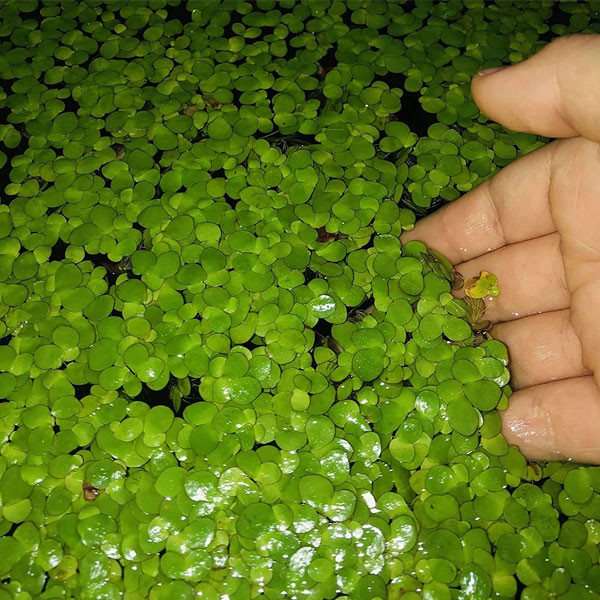
Giant Duckweed, (Spirodela polyrhiza), Natural Biological Filter, 20 + Live Floating Plants for Pond and Aquarium
Giant Duckweed, (Spirodela polyrhiza) Live Floating Aquatic Plants Natural Water Purifier

Spirodela polyrhiza is a perennial aquatic plant usually growing in dense colonies, forming a mat on the water surface. Each plant is a smooth, round, flat disc 0.5 to 1.0 cm wide. Its upper surface is mostly green, sometimes red, while the lower surface is dark red. It produces several minute roots and a pouch containing male and female flowers. The top part dies in the fall and the plant often overwinters as a turion. The turion sinks to the bottom of the water body and stays in a dormant phase, until water temperature reaches 15 °C. The turions then germinate on the bottom of the water body and start a new life cycle. As this species lives in ponds and slow-moving water bodies, differs developmentally from terrestrial plants in morphology and physiology. It undergoes mainly vegetative growth in spring and summer, forming new fronds. Spirodela polyrhiza rarely flowers. In fall and winter it switches into a dormant phase represented by the turions due to nutrition starvation and freezing temperatures. Large scale cultivation is done in outdoor water tanks, mostly in connection with wastewater treatment. Tanks are fed with wastewater and the floating duckweed is harvested from the surface. It is then further used as a biofuel from industrial wastewater or as animal feed from agricultural wastewater treatment facilities. Spirodela polyrhiza can be used for bioremediation, removing toxic substances from aquatic environment as well as cleaning eutrophic waters, especially in wastewater treatment plants. Its uses as biofuel and animal feed are also gaining importance. It is hardly used for human nutrition.Greater duckweed has been used to remove common pollutants from wastewater. In a laboratory setting, S. polyrhiza showed a maximum of 90% removal efficiency of nitrate, 99.6% of phosphate and 69.8% of sulphate. The efficiency for all three pollutants combined was 85.6%, which makes it an environmentally and economically viable bioremediatory for wastewater treatment.



Frequently Bought Together
No frequently bought products found!
Products from this Seller
View All














Aquarium Medicine Combo









Share with Friends
Trading is more effective when you share products with friends!Share you link
Share to